
Preparation
The first step is to mark out the area to be paved. We will then carry out all excavation of the existing surfacing, making sure that the finished level of the new paved area will be at least 150mm below the damp proof course of any adjoining property. All excavated material is cleared from site or if necessary placed into skips as required.
During this preparation stage it is important for us to establish the correct levels for drainage purposes. If the area slopes towards the property then drainage channels, gullies or a soak away will be necessary. These will be installed at this stage along with any recessed manhole covers that may be necessary. This will be discussed with the customer prior to any work commencing.
Edging
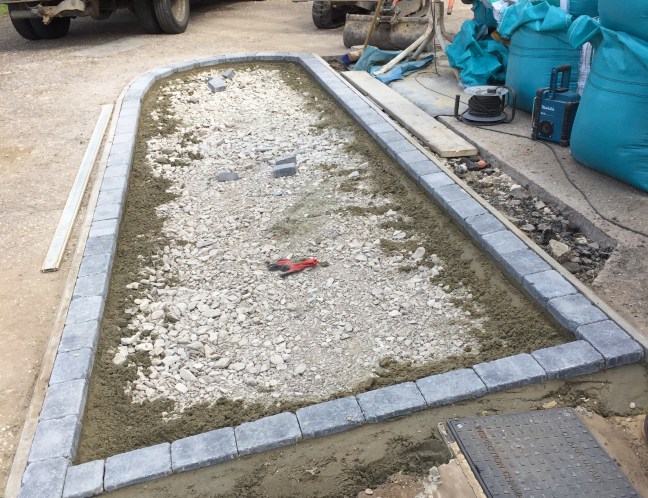
All edge restraints are installed by setting firmly in concrete to the correct levels and haunched. Restraints can be kerb edgings, pre-cast edging, or blocks themselves. The blocks can be laid with the short side against the edge (a header or soldier course) or long ways against the edge (a single or double stretcher course) depending on your personal preference.
Laying the Blocks
The sub-base material (MOT type 1) is then laid within the edge restraints and compacted firmly with the plate vibrator. At this stage we spread sharp sand to a depth of 50mm, compacting it with the plate vibrator. A further 15mm of sharp sand is then spread over the area as a loose screed and levelled by drawing a rigid piece of timber across it. This becomes the laying surface.
The blocks are then laid by hand, blocks are cut and in filled to the edge restraints. To ensure maximum strength pieces smaller than one third of a block are avoided where possible.
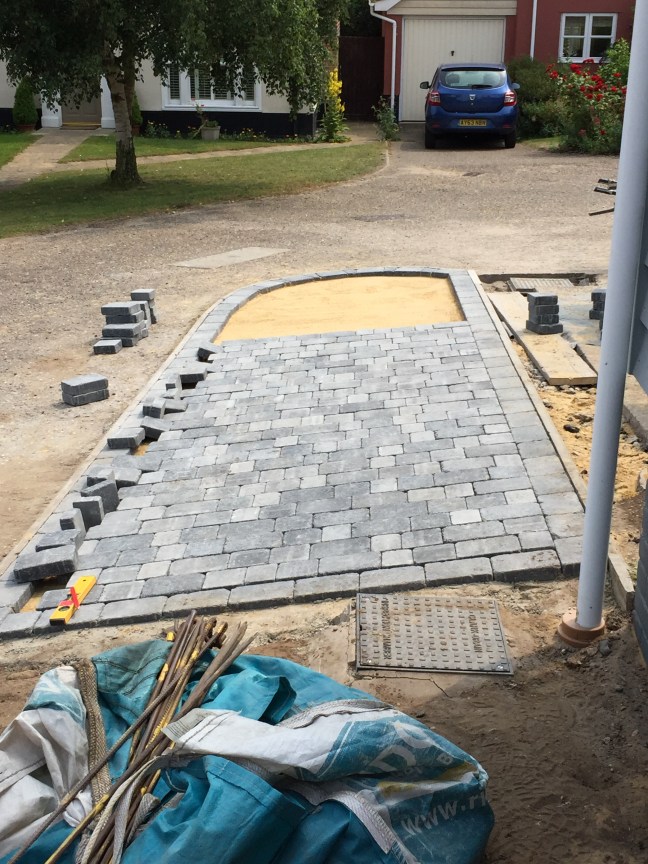
The whole area is then compacted with two or three passes of the plate vibrator. We then sweep kiln dried joint filling sand over the entire area, ensuring it gets right into all the joints between the blocks.
Finally we vibrate the whole area again to force down the joint filling sand and fill any gaps, which may appear in the joints. The excess sand is swept off the surface to reveal the finished driveway.
 MGF Norfolk Ltd